Maxxit Team
From Manual Trading to Trustworthy Agents: Why Maxxit Exists
Trading didn't start with bots or agents. It started with humans making judgment calls.
You'd track a handful of sources, build conviction, place the trade, and stay glued to the chart until exit. That workflow still works.
But in crypto, it comes at a brutal cost:
- It eats time
- It's emotionally expensive
- You miss moves when you're offline
- And even when your idea is right, execution can be sloppy
Maxxit exists to take that pain out.
Maxxit is a non-custodial trading platform where AI agents handle the repetitive human actions 24/7 while you keep control. It turns signals from sources you trust into real trades, sizes them to your risk style, routes them to the best venue, and monitors positions continuously.
The Evolution: Humans → Bots → Agents
(and why trust became the missing piece)
1) Manual Trading: Smart, but Human
Manual trading is basically three steps:
- What to trade (pick the asset)
- How to trade (size, leverage, risk)
- Where to trade (venue + execution + monitoring)
Humans are good at context and judgment. But we're also inconsistent, emotional, not available 24/7, and hesitant at critical moments.
That's why even good alpha often doesn't translate into good results.
2) Bots: Tireless, but Static
Bots solved one thing: stamina. They can run all day. They don't get tired. They don't panic.
But bots are rigid. They follow fixed rules. They can't really understand messy, human alpha like:
- A trader's tweet
- A research note
- A Telegram call with nuance
So bots are consistent, but they're not great at turning "human signals" into "trade instructions."
3) Agents: Dynamic, but Hard to Trust
Agents can interpret context and adapt. But most "AI agents" hit a trust problem:
If you feed the same market info into many AI systems twice, you might get two different answers. That randomness is fine for brainstorming. It's not fine for a system that can place trades.
And there's a second problem people miss:
Trading needs objective parameters. Humans can act on vibes. Machines can't.
A human can read:
"This looks bullish, maybe rotate into ETH soon."
…but an execution system needs something more structured:
- Which asset?
- Direction?
- Entry trigger?
- Invalidation point?
- Sizing rules?
- Time horizon?
If an agent can't reliably convert human alpha into objective, repeatable trade instructions, it'll either do nothing or do unpredictable things.
That's where Maxxit comes in.
Maxxit Breaks Down Trading: WHAT → HOW → WHERE
Maxxit covers the full trading cycle with three agents.
Step 1: WHAT to Trade (Picking the Right Signals)
Humans start with trust. You follow certain accounts or groups because you believe they move markets.
Example:
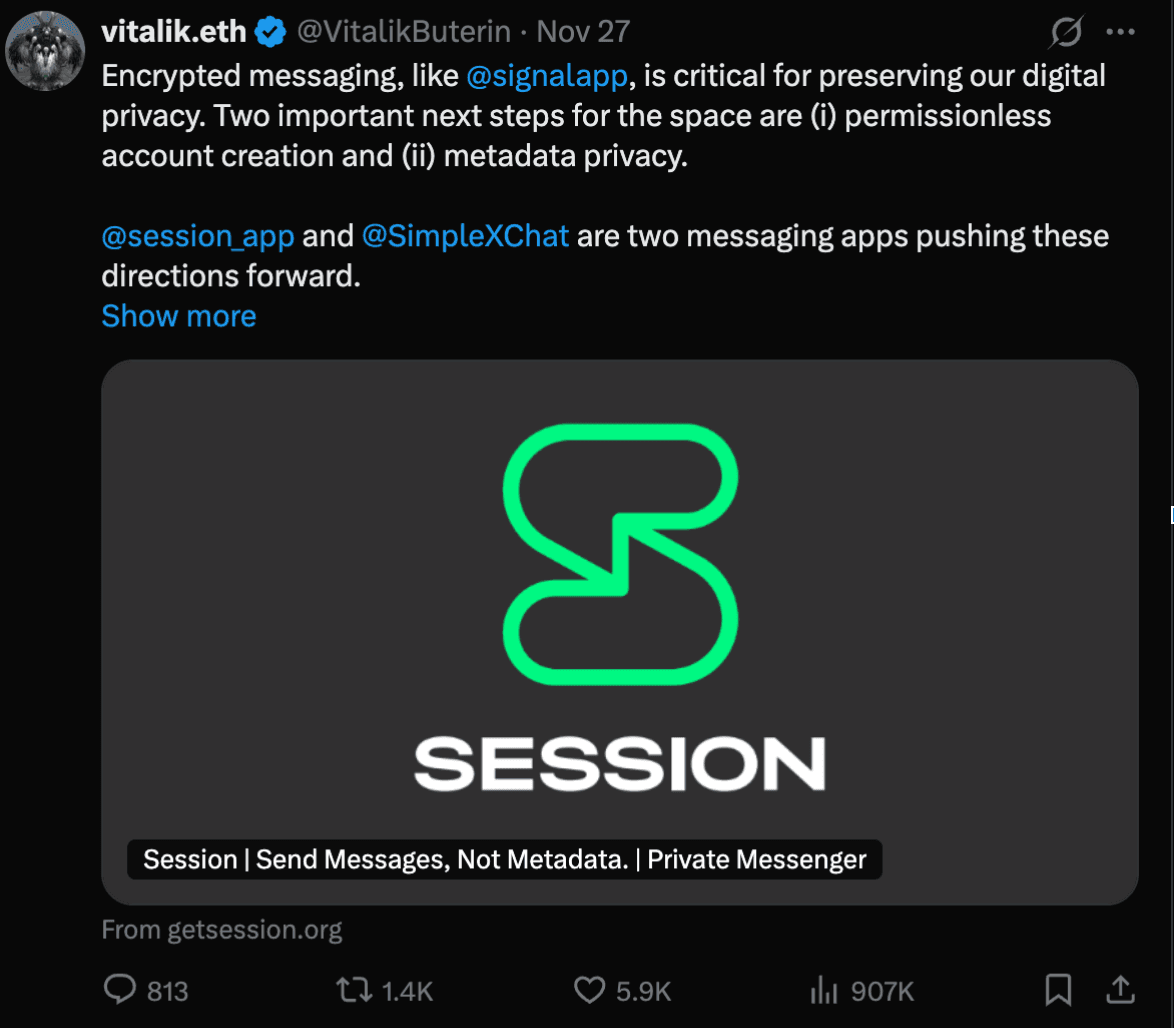
Let's say you believe Vitalik's posts influence market sentiment. In Maxxit, you can select Vitalik as a source. When he posts, Maxxit treats it as real-time signal input along with research firms and private Telegram channels.
↑ Market Impact
Example - The following tweet resulted in Session token ($SESH) zooming up by 500% within hours of posting.
But here's the key: Maxxit doesn't just "copy tweets."
It does two things that make this programmable:
(a) Benchmark Sources by Performance
Maxxit tracks outcomes over time and scores sources by their realized impact. So instead of "who's loud," you get "who's right often enough to matter."
(b) Convert Human Alpha into Objective Trade Parameters
This is the bridge most systems miss. Maxxit turns messy human content (tweets, notes, calls) into structured intent an agent can actually trade:
- Asset + direction
- Strength/conviction
- Suggested horizon
- Risk cues (tight vs wide invalidation, momentum vs mean reversion)
- Confidence signal for downstream sizing
So the agent isn't trading "a post." It's trading a clean instruction.
Why Deterministic AI Matters
If an agent reads Vitalik's post today and labels it "bullish ETH", it should label it the same way tomorrow if nothing changed.
That's what deterministic AI gives you: consistent decisions instead of "AI mood swings."
- ✓ Outputs are reproducible
- ✓ Behavior becomes predictable
- ✓ Debugging becomes possible
Step 2: HOW to Trade (Your Trading Clone)
Even if two people agree on a trade, they won't trade it the same way. One uses 2% size. Another uses 10% with leverage. One scalps. Another holds.
That's why traditional copy trading breaks: it copies exact trades and assumes you're the same trader.
Maxxit does something more natural:
It copies the intelligence (the idea) but executes it through your style.
AGENT HOW becomes your Trading Clone:
- Position sizing tuned to your risk tolerance
- Leverage/exposure aligned to your preferences
- Market + on-chain context awareness
- Consistent execution without emotional drift
So you're not copying someone's exact trade. You're copying their edge, then trading it like you.
Step 3: WHERE to Trade (Best Venue + 24/7 Monitoring)
Execution matters: slippage, liquidity, fees, liquidation risk, and exits you can't manage offline.
AGENT WHERE routes to the best venue available and monitors positions continuously, protecting exits and preventing "I forgot to check" liquidations.
Proof It Works: 6,266 Signals Over 6 Months
(not theory)
Maxxit isn't a "nice idea on paper." We validated the system on a real signal stream over a meaningful period:
We benchmarked performance in the exact way a user experiences the product, by "turning on" agents step-by-step:
Same signals, but personalized sizing/risk
Benchmarked source selection + personalized execution
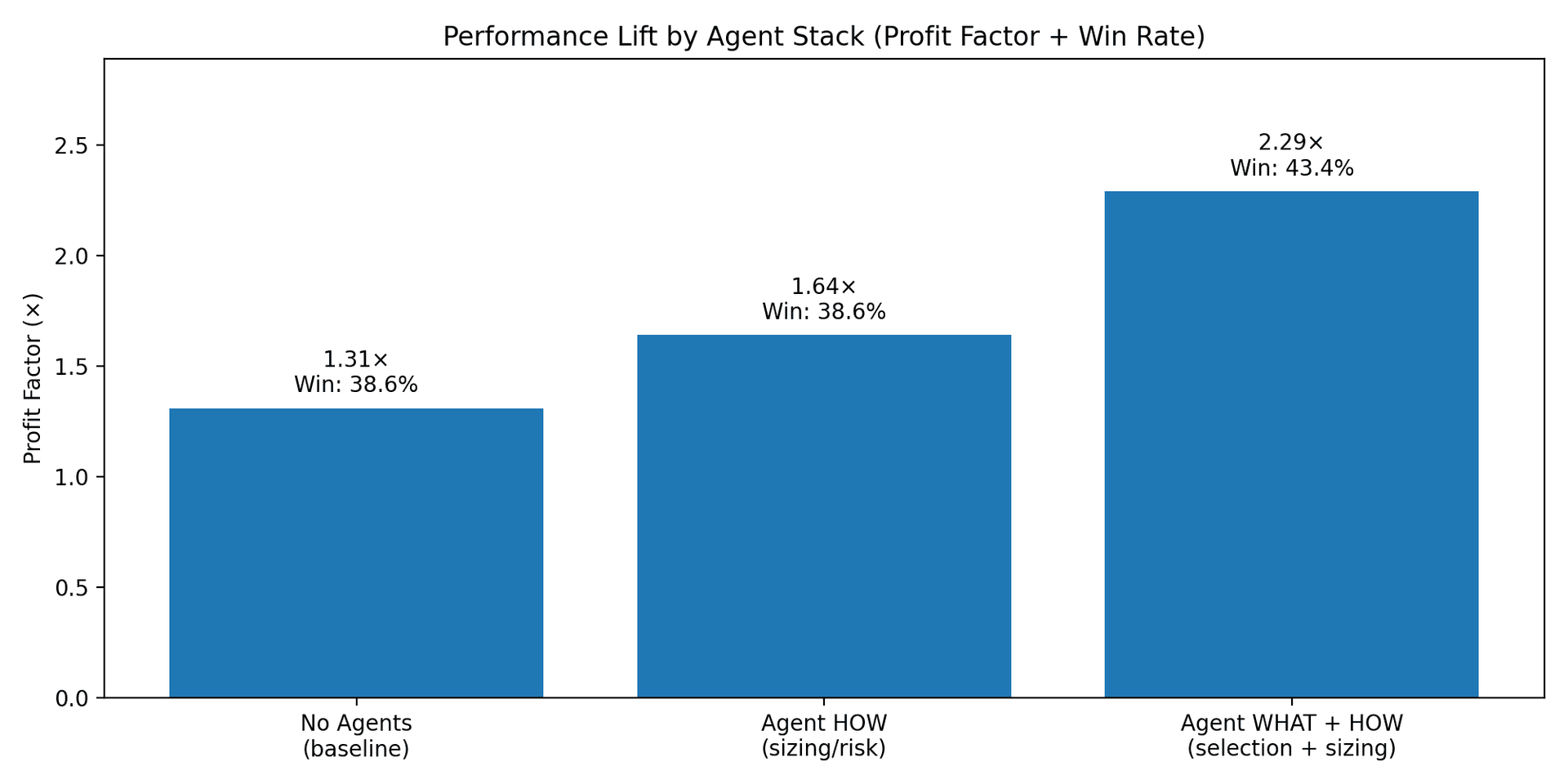
Takeaway: Performance improves when the system does what humans struggle with most: source selection + disciplined sizing, continuously.
New "Lazy Trading" Workflows Become Possible
Once trading becomes agentic and non-custodial, completely new behaviors appear.
Imagine you don't want dashboards, charts, or constant monitoring. You just want one simple thing:
"If something important happens, trade it for me safely."
With Maxxit, you can:
- Drop alpha into a Telegram DM (your own notes, a forwarded call, a link, a tweet)
- The system converts it into objective parameters
- AGENT WHAT validates it against benchmarked sources + context
- AGENT HOW sizes it to your preferences
- AGENT WHERE executes and monitors it
The "Lazy Trader" Example
You are watching a football game and your friend shares that BTC is gonna go up because blah blah blah. You trust your friend but still want a second opinion, and if that opinion turns out the same, you also want to take the trade.
So what you could do is text Maxxit listener agent on Telegram:
This will start the entire cycle where your text will be analysed alongside market data by Agent WHAT, which will be further passed to your Agent HOW who will decide the size, target, etc and pass it to Agent WHERE to execute the trade & monitor for exit.
Here you save time of the entire process and do not miss the trade.
So even a "lazy trader" can participate in markets responsibly because the system handles the hard part: turning messy human input into disciplined execution.
Why Delegate Your Trades to Maxxit
Maxxit gives you back your time, energy, and focus, without giving up custody.
Stop Paying for Noise
Instead of subscribing to 20 Telegram groups, subscribe once to Maxxit's Alpha Clubs, a compilation of benchmarked, proven sources.
Stop Doom-Scrolling X
Maxxit scans X and Telegram for you, filters the signal from the noise, and converts it into actionable trades.
Stop Doing Endless Research
Maxxit consumes market research and translates it into objective trade instructions you can actually execute.
Stop Rushing to Execute
No more opening charts in panic. Maxxit acts as your always-on trading butler, executing 24/7.
Stop Venue-Hopping
Maxxit routes trades to the best venue automatically (fees, liquidity, slippage, pairs).
Stop Losing Sleep for Exits
Go offline while Maxxit monitors positions and manages exits timely, including liquidation prevention.
All of This Stays Non-Custodial
Your funds remain in your wallet.
And it's auditable: decisions and performance trails are verifiable, not a black box.